

The other day I was asked what my preference was between strategy and doing. Obviously, the “strategy” answer first comes to mind. But when wanting to be successful, is being all about strategy that good a choice, or are there examples out there proving otherwise?
At Kellogg School of Management, Northwestern University in Chicago, I sat in a lecturing room with 30+ people, varying from a US Army Colonel, NGO directors and CPG marketers. We had the pleasure of having a session with Professor Edward Zajac. Zajac is an award-winning scholar, who’s research, teaching and consulting focuses on strategy, alliances and corporate governance.
He explained in a straightforward diagram how organizations deal with challenges. Basically, paraphrasing, it came down to the following: when faced with a problem, most organizations spend 80% of their time and efforts on strategy, and 20% on a solution for their issue. Having agreed on this solution, they then divide their attention for 80% to procedures, structure and governance. The remaining 20% they spend on the actual implementation of said solution. After drawing this tree out, he then faced the classroom and explained: “So if you then want to see how you will do, you multiply the solution (20%) with the implementation (20%), giving you a 4% chance of success… And you wonder why you fail.”
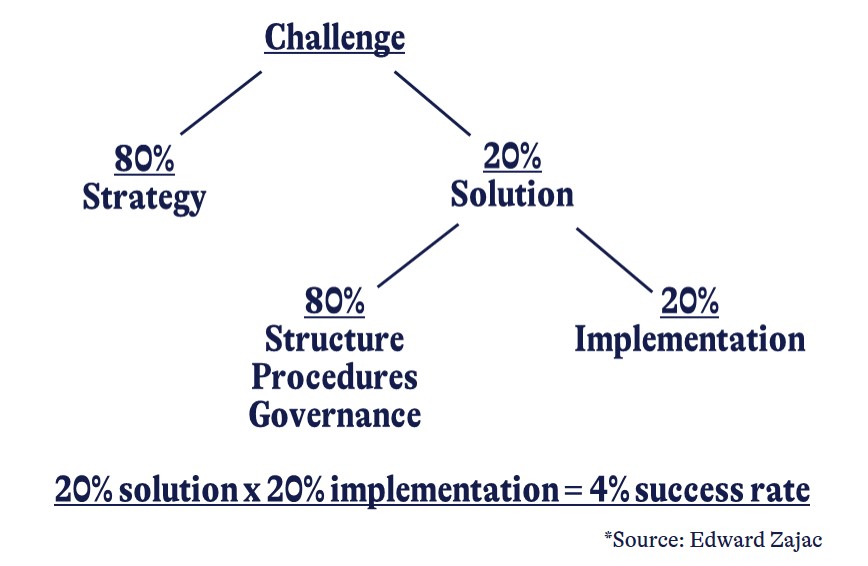
The entire room looked up with a “how does this feel extremely familiar?” expression on their faces. Because it is so true. The left part of the diagram is the “safe” zone. Here, you can freely sprout intellectual sounding PowerPoints, brainstorms and flowcharts. You can linger forever in this realm, without ever being burned. The right side is the danger zone, that is where the action happens. The actual solution, the implementation, it’s all very real, tangible and SMART. It could cost you, then again, it is also rich with fame and fortune for the happy few.
There are some girls and boys who make it all appear to be very easy, they seem to accomplish everything quite fast and adequately. Their secret? They have altered the 80-20 into a for example 50-50 model, making them six times more effective versus most people around them.
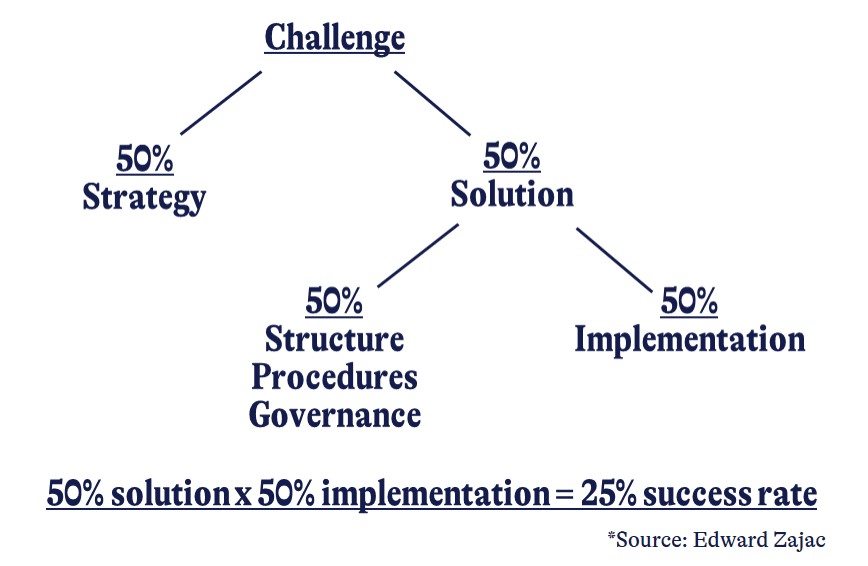
I have experienced firsthand what happens when those dials are shifted, back when developing the Blade at Heineken. Blade is the countertop draught system with an 8 liter air compressed keg suited for any environment, Friday drinks at the office to a small restaurant. It meant convincing an entire multinational the Blade being a top commercial priority for most markets, including supply chain and finance. We went from idea to actual roll out within 2 years’ time, during that period having to develop the commercial proposition & assets, the actual machine, the kegs and the filling lines, none of which existed. The Blade is now rolled out in over 30 markets with more than 100.000 units, 10 filling lines and 30+ brands available. All because we shifted the dials and became way more effective.
If you’re faced with introducing a disruptive new campaign, an NPD that’s stuck in a development swamp, or want to inspire your team with a story like this, give me a ring.

 Boorsch.com
Leave a comment